If you are pricing an in-ground pool for your Western PA home in 2026, the honest range is $55,000 to $100,000 or more. That is not a dodge, it is the real spread once you factor in the type of shell, your site, the hardscape around the pool, permits, and the equipment you pick. This guide breaks that range into tiers you can plan against and calls out the regional factors that move the price: soil, slope, township code, the Pennsylvania freeze-thaw cycle. It also walks through the line items most quotes leave out. We build pools across Butler, Allegheny, and Beaver counties, and every number below is what we are currently paying subs and quoting homeowners this year.
On this page
The short answer: 2026 pricing by pool type
Every legitimate in-ground pool quote we write in Western PA in 2026 lands in one of three tiers. These match the tiers in our project planner, and they match what a serious local builder will realistically quote you.
| Tier | 2026 price range | What you get |
|---|---|---|
| Entry | $55,000 – $70,000 | Fiberglass or vinyl liner pool in a standard rectangle or kidney shape (roughly 14x28 to 16x32). Core equipment package, a simple concrete or 8-foot paver apron, and code-compliant fencing. Flat-to-gently-sloped yard. No water features. |
| Mid-tier | $70,000 – $85,000 | Larger shell (up to 16x38), upgraded paver patio in the 400-600 sq ft range, LED lighting, variable-speed pump, basic automation, and a seating wall or low retaining wall. Starts to feel like a finished outdoor room. |
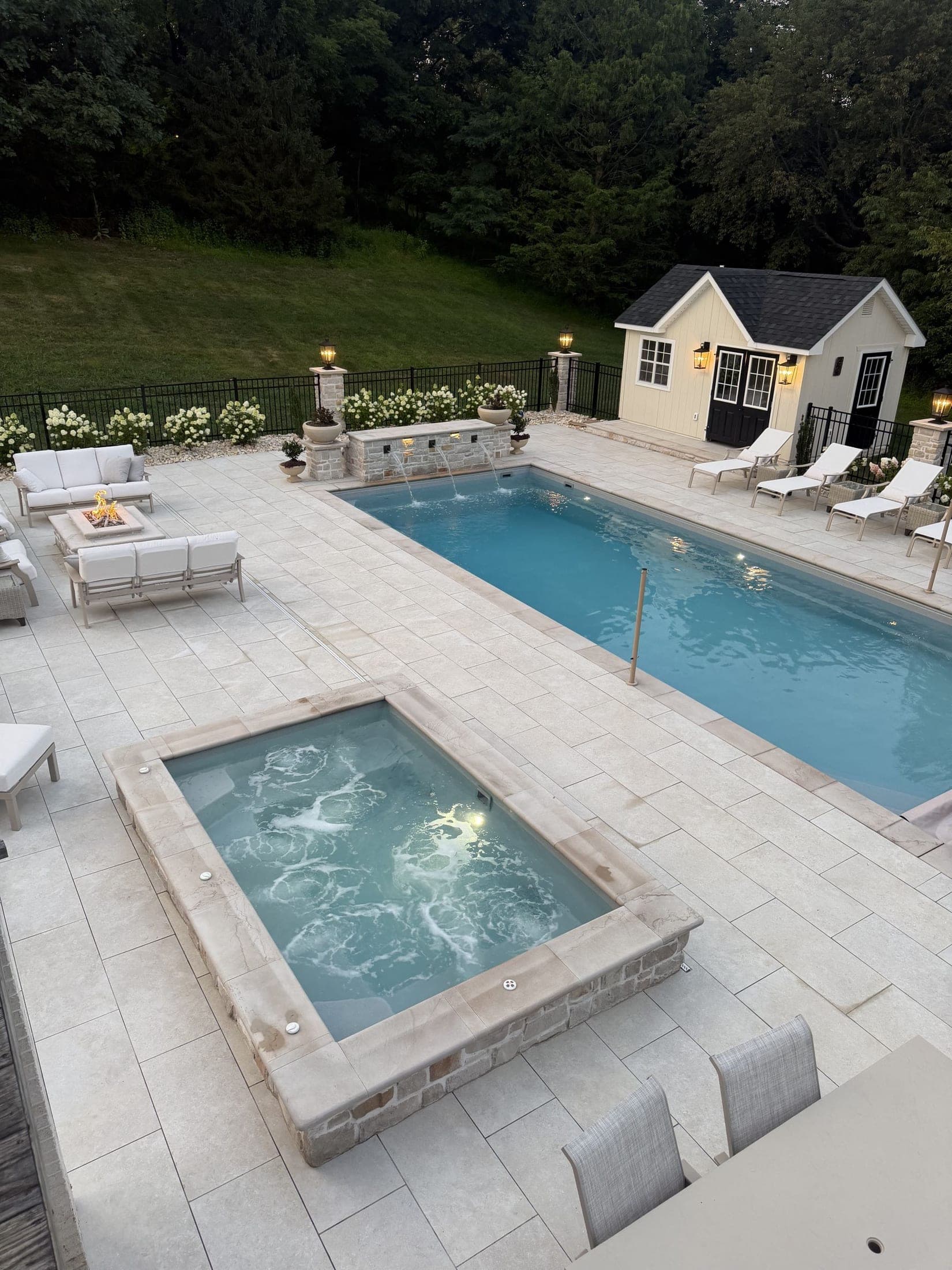
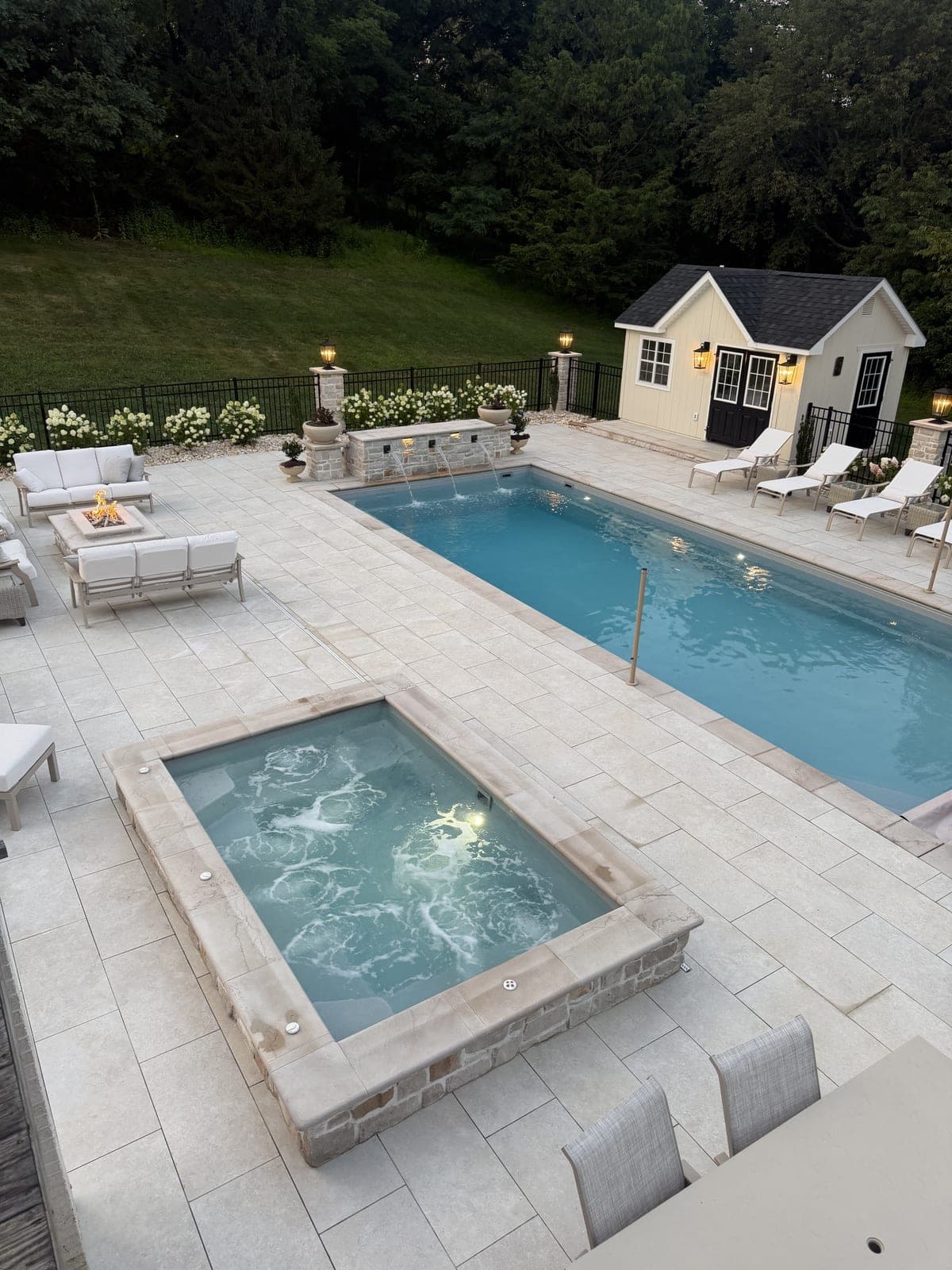
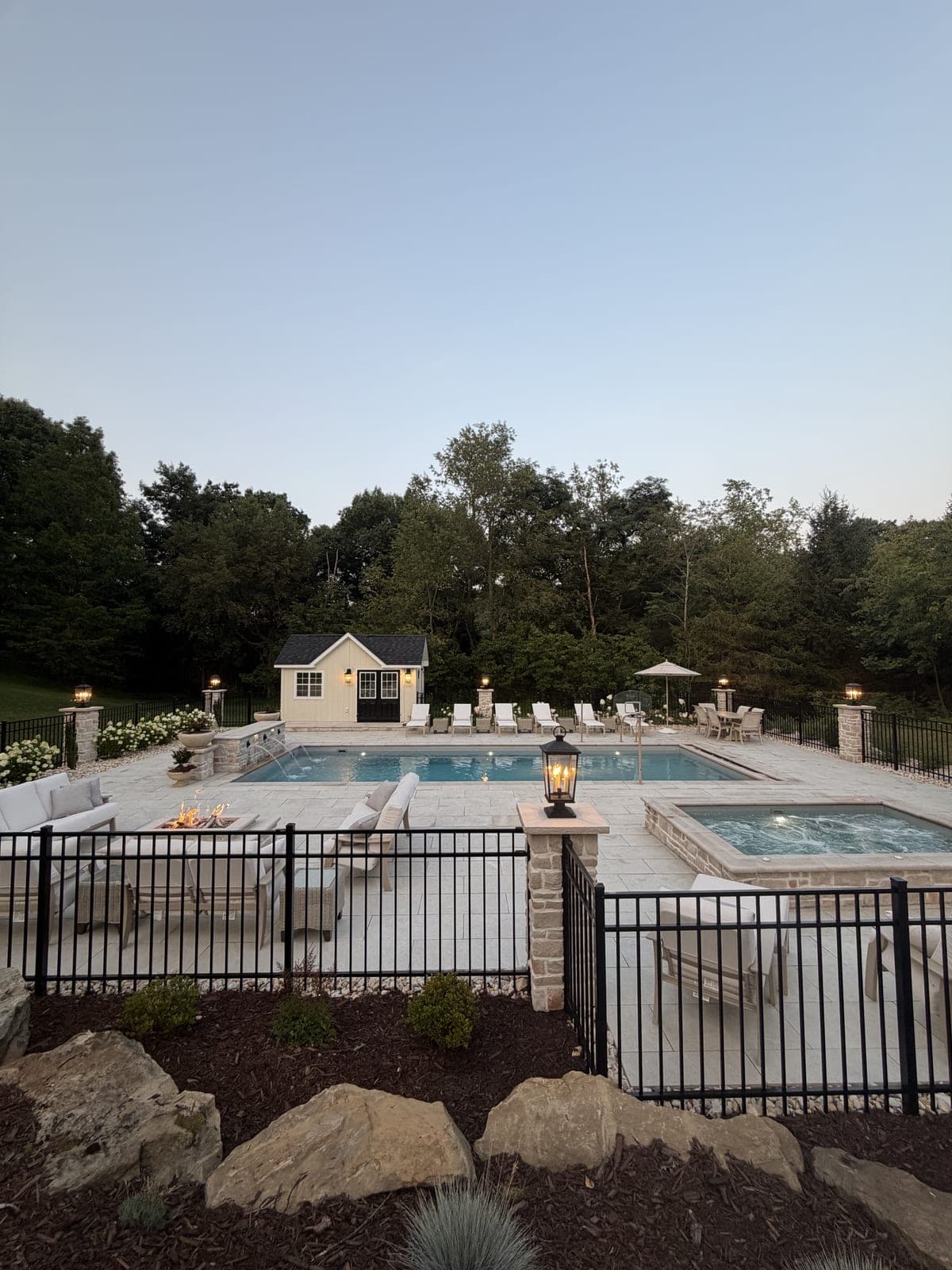
| Premium | $85,000 – $100,000+ | Custom shape, integrated spa or tanning ledge, 800+ sq ft of paver or natural stone, full automation, saltwater system, water feature, and full landscape design around the pool area. |
These are 2026 numbers for Western PA. Expect higher quotes in Pittsburgh’s eastern suburbs (Fox Chapel, Sewickley Heights) where site access and labor run a premium, and slightly lower numbers out in Butler County on flat lots with easy driveway access.
What drives the price
If two houses on the same street get quotes $25,000 apart, it is almost never the shell. It is the dirt, the grade, and the hardscape. Here are the factors that actually move the number.
1. Pool type and size
A 14x28 fiberglass shell runs roughly $22,000–$28,000 delivered; a 16x40 custom vinyl liner shell is closer to $30,000–$38,000. Every two feet of added length brings more excavation, more backfill stone, more coping, and a bigger filter. Size compounds.
2. Excavation and site prep
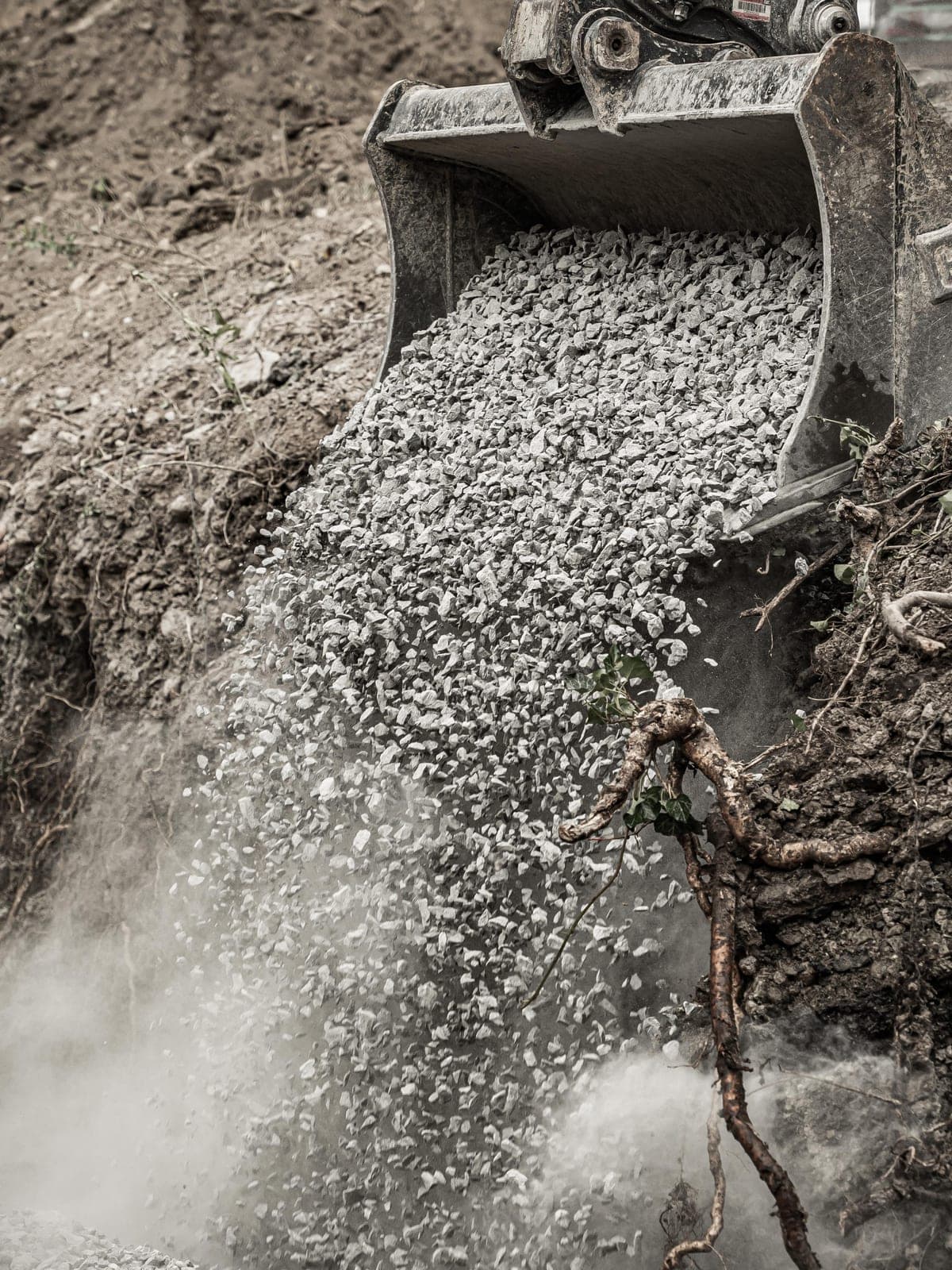
In most of Butler, Allegheny, and Beaver counties, you will hit heavy clay by the second shovel. Clay backfill does not drain, so a proper install uses #57 washed stone (about $55–$75 per ton delivered in 2026) around the shell. If the excavator hits shale or sandstone, budget $2,000–$10,000 extra for a rock hammer. Spoils removal, hauling the dirt off your property, adds another $1,500–$5,000 if there is nowhere on site to redistribute it.
3. Site access and slope
A pool on a flat corner lot with driveway access gets built for less than an identical pool at the bottom of a sloped Fox Chapel backyard. If a mini-excavator cannot reach the dig area in one pass, we bring in a smaller machine, hand-dig sections, or remove a section of fence. Each of those adds a day or two of labor. Sloped lots often need a retaining wall, which is its own line item.
4. Decking and hardscape
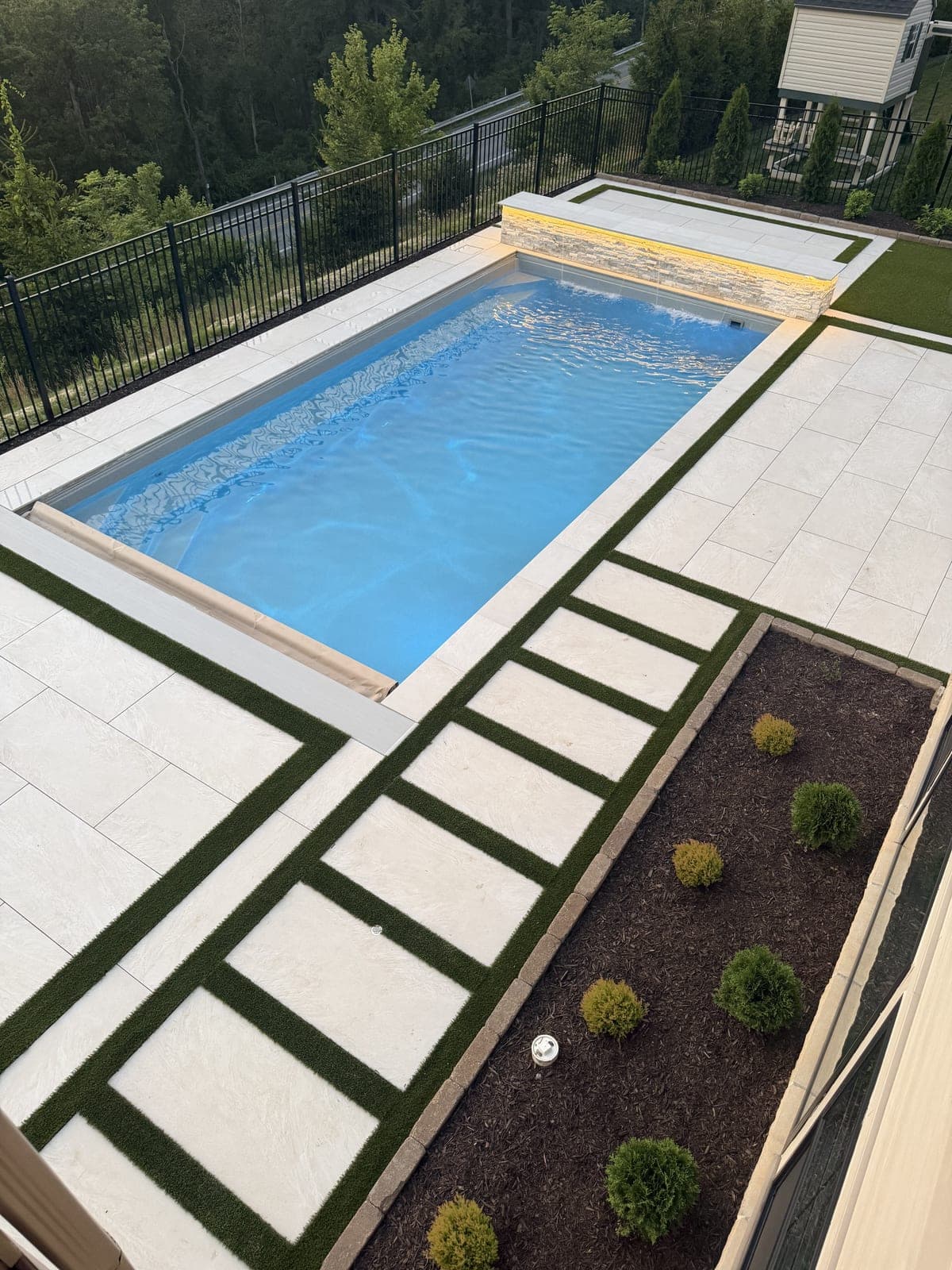
The patio around your pool is the single biggest swing factor. A plain broom-finish concrete apron is $8–$12 per square foot installed. A paver patio runs $22–$32 per square foot. Natural stone (bluestone, travertine) sits at $35–$55 per square foot. Go from a 300 sq ft apron to a 700 sq ft outdoor living space and you have added $15,000–$25,000.
5. Retaining walls and grading
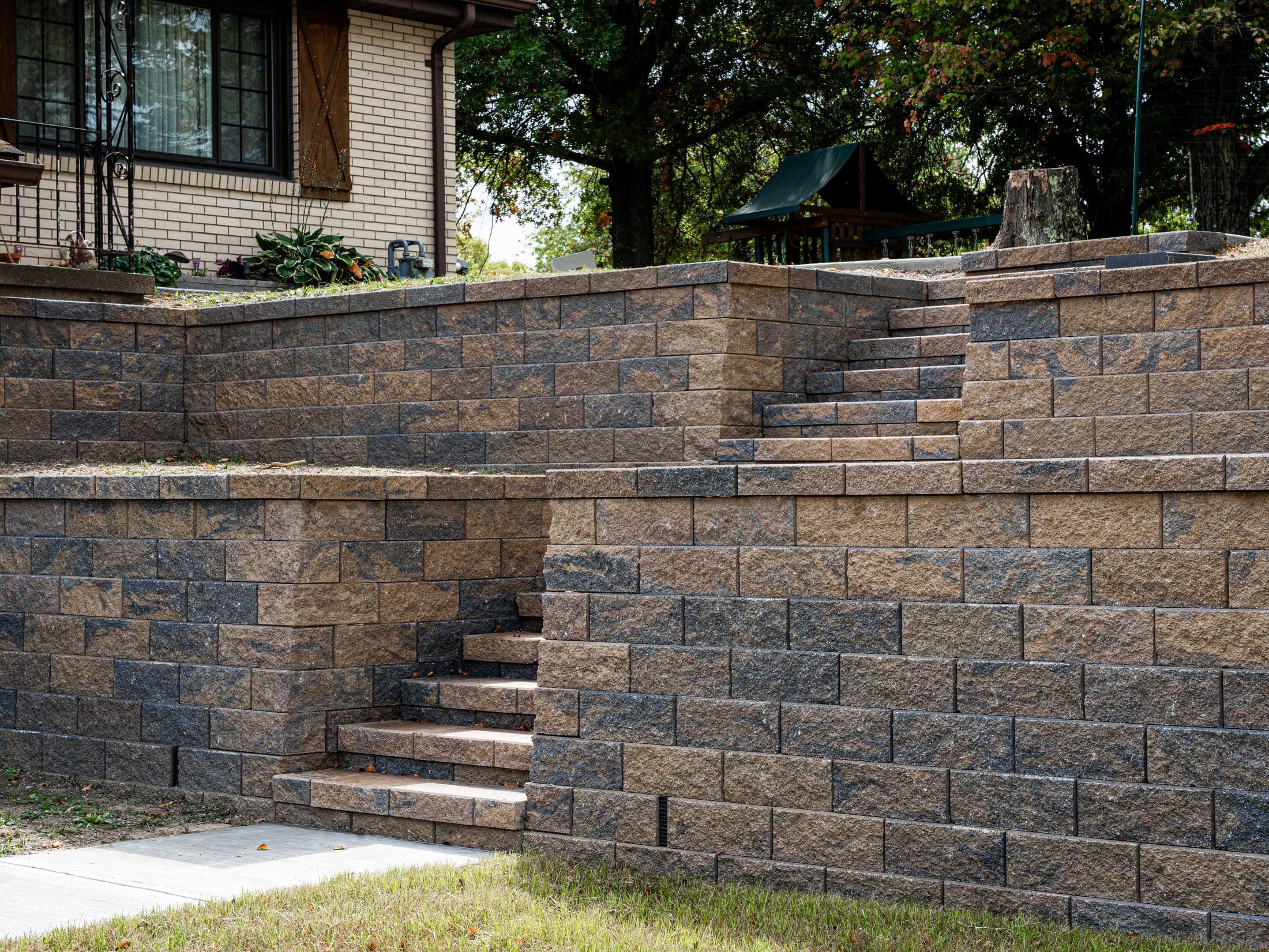
Almost every sloped yard in the North Hills needs at least one retaining wall to create a level pool pad. Segmental block walls run roughly $45–$75 per face square foot installed. A modest 30-foot wall at 3 feet tall is about $4,000–$7,000; a tiered hillside system can cross $25,000. Run the numbers on our retaining wall price calculator if the slope is steep.
6. Equipment and automation
A base equipment pad (single-speed pump, cartridge filter, basic chlorine) adds $5,000–$7,000. A mid-tier setup (variable-speed pump, salt system, LED lighting, basic app control) runs $9,000–$13,000. Full automation with a gas heater, heat pump, and integrated smart controls is $15,000–$22,000. Variable-speed pumps are now code in Pennsylvania on new installs, so plan on at least the mid tier.
7. Permits and code
Butler County and Allegheny County townships typically charge $300–$800 for the pool permit itself. Add an electrical permit ($75–$200), a fence permit ($50–$150), and often a separate gas permit if you are running a heater line. Cranberry Township, Adams Township (Mars), and Marshall Township (Wexford) all require engineered drainage plans on sloped lots, a $400–$900 line from the civil engineer.
8. Water features and extras
A sheer descent waterfall kit installed: $3,500–$6,000. Deck jets (pair): $2,500–$4,000. A tanning ledge integrated into the shell: $4,000–$7,000. A raised spa plumbed into the pool: $15,000–$25,000. These are the features that turn a Tier 2 project into a Tier 3 project in a hurry.
Fiberglass vs vinyl liner: which is right for you?
We install both. They are both good products. Concrete and gunite pools are rare in Western PA because the freeze-thaw cycle beats them up, and nobody wants to resurface a pool every 10 years. So the real decision is fiberglass vs vinyl.
Fiberglass
Pros: 4–6 week install from dig to swim. Smooth gelcoat surface that does not snag feet or bathing suits. No liner to replace, the shell typically lasts 25–30+ years with no major refinish. Lower chemical usage because the surface is non-porous. Salt-system compatible out of the box.
Cons: you pick from the manufacturer’s catalog of shapes. Custom freeform designs are not an option. Shells larger than 16x40 are a logistical challenge to truck into some Western PA neighborhoods, we have turned away jobs where the only route involves a narrow hillside street. Upfront cost is $3,000–$8,000 higher than vinyl for the same footprint.
Vinyl liner
Pros: any shape you want. Easier to truck into tight-access sites because the panels ship flat. Lowest upfront cost in the entry tier. The liner itself is soft underfoot.
Cons: the liner replaces every 7–10 years. Current pricing in Western PA is $4,500–$8,000 for a full replacement including water. Liners can tear if you drop a metal patio chair in the pool. Slightly higher chemical usage because the liner surface is more porous than gelcoat.
Our honest take: if your shape fits a fiberglass catalog and your site allows delivery, fiberglass is usually the better long-term value, you pay more day one but skip three or four liner replacements over the life of the pool. If you want a custom shape, a tight-access lot, or the lowest possible entry price, vinyl is the right answer.
Hidden costs most people miss
A clean pool quote covers the shell, the equipment pad, the coping, and the immediate apron. It often does not cover these. Ask any contractor to price them in writing before you sign.
- Fencing: Pennsylvania requires a 48-inch barrier with a self-closing, self-latching gate. Aluminum pool fence runs $35–$55 per linear foot installed. A typical 150-foot perimeter is $5,000–$8,500. Ornamental iron or privacy fence runs higher.
- Electrical sub-panel and bonding: $2,500–$5,000. Every metal fixture within 5 feet of the pool has to be bonded to a common grounding grid, and most older panels need a new sub-panel dedicated to the equipment pad.
- Gas line for heater: $1,500–$4,000 depending on run distance from the meter. If your meter is on the opposite side of the house, this line item surprises people.
- Water fill-up: $300–$800 from the tap. Some homeowners truck it in to avoid spiking a quarterly water bill, that is another $400–$900.
- First-season chemicals and startup: $400–$700 for opening chemistry, stabilizer, and the initial shock cycle.
- Winter closing (every year after): $400–$600 for a professional closing with a safety cover. Add $150–$250 if you need a new cover.
- Homeowner’s insurance bump: $50–$150 a year added to your premium.
- Landscape restoration: excavators tear up grass. Re-seeding, new topsoil, and any replanting is usually $1,500–$4,000 if your builder does not include it.
Totaled up, these line items add $8,000–$20,000 to a pool project, and they almost always exist. A contractor who writes a $54,000 quote with none of this in it is not cheaper than a $68,000 quote that includes it. They are just hiding where the change orders will come from.
What our past projects actually cost
Three recent builds, anonymized. Real sites in Western PA, real 2025–2026 numbers.
Tier 1: family pool in Baden ($58,400)
A young family on a half-acre flat lot wanted a clean 14x28 fiberglass rectangle, straightforward equipment, and a concrete apron. Driveway access ran right to the back yard, so excavation was fast. We installed the shell, a broom-finish concrete deck at about 400 sq ft, a single-speed pump with a cartridge filter, a salt chlorinator, and 160 feet of aluminum pool fence. Final contract was $58,400. No water features, no retaining walls, no automation. The family swam in it 38 days after we signed.
Tier 2: entertainer pool in Cranberry Township ($78,900)
Corner lot on a gentle slope in Cranberry. The homeowners wanted a 16x36 fiberglass pool, an upgraded paver patio around 550 sq ft with a matching seating wall, LED lighting, a variable-speed pump, and basic automation they could run from their phone. The lot needed a short 24-inch retaining wall on the uphill side to hold the pad. We priced the whole package, pool, decking, wall, lighting, fence, equipment, permits, landscape restoration, at $78,900. They close the pool professionally each October for about $525.
Tier 3: backyard resort in Wexford ($96,200)
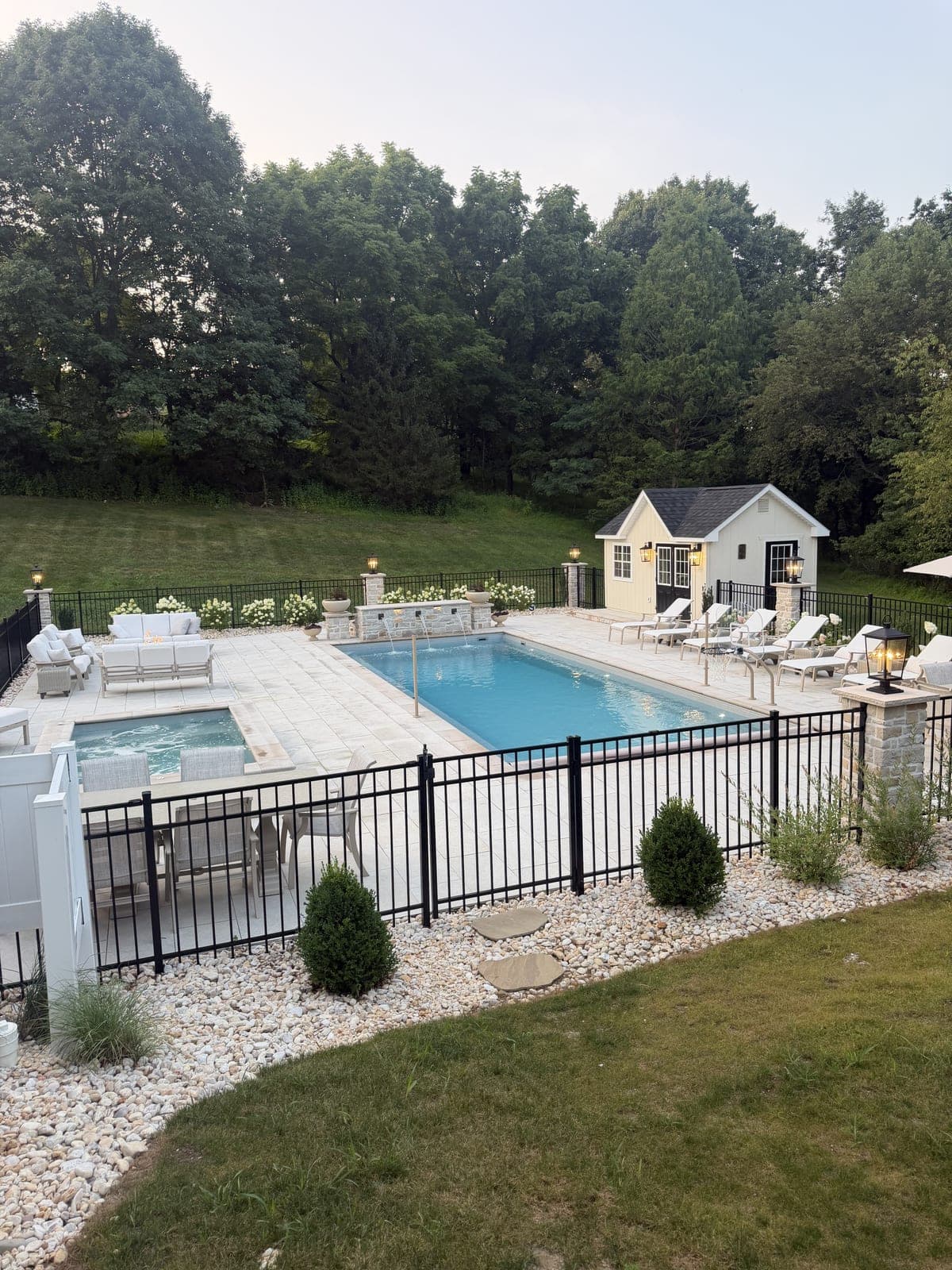
Sloped two-acre lot off Route 910. The owners wanted a freeform vinyl liner pool with a raised spa spilling into it, a tanning ledge, a sheer descent water feature, and 900 sq ft of natural stone decking wrapping down to a lower fire-pit terrace. Two tiered retaining walls held the pad. Full automation, a gas heater tied into an existing propane tank, and integrated landscape lighting. Contract came in at $96,200. Build time was 14 weeks from dig to first swim.
Timing: when to book for 2026
Pool season in Western PA is short, and good builders book out fast. Here is how the calendar works in 2026.
- November 2025 – February 2026: best time to sign a contract for a summer 2026 swim. First pick of build dates, pricing locked before spring material increases hit.
- March – April 2026: permit submittals. Butler County is taking roughly 3–4 weeks; Allegheny County townships are running 4–6 weeks. Cranberry Township requires an engineered drainage review that adds another 1–2 weeks on sloped lots.
- April – May 2026: dig dates start as soon as the ground thaws and the frost leaves. Fiberglass pools can be swimming by Memorial Day if the contract was signed by February.
- June – August 2026: peak build season. New contracts signed in this window typically schedule a dig date in late summer or fall.
- September – November 2026: fall installs. A smart option: digging happens in the shoulder season and the pool is ready to open Memorial Day 2027, with crews carrying more capacity than in June.
Typical deposit schedule
Our contracts run on a four-stage draw: 10% at signing, 40% at excavation and shell delivery, 40% at patio and equipment install, 10% at final walkthrough. Most reputable Western PA builders use a similar structure. Be very cautious about any contract that asks for 50% or more upfront before a shovel hits the ground.
Build duration by tier
- Tier 1 fiberglass with concrete apron: 4–6 weeks from dig to swim.
- Tier 2 fiberglass with full paver patio: 8–10 weeks.
- Tier 3 custom vinyl or fiberglass with hardscape, walls, and landscape: 12–16 weeks.
Add 2–6 weeks for permits before any of those clocks start. If you are also planning a new pool installation alongside a larger outdoor living project, our full pool installation guide walks through the six-phase construction process in detail.
Frequently asked questions
What is the average cost of an in-ground pool in Western PA in 2026?
Most projects land between $55,000 and $100,000. A simple fiberglass or vinyl liner pool with a modest concrete apron starts around $55,000–$70,000. A mid-tier build with upgraded equipment and a paver patio runs $70,000–$85,000. A premium pool with custom surroundings, water features, and integrated landscape design is typically $85,000–$100,000 or more.
Is fiberglass or vinyl liner cheaper?
Vinyl liner is $3,000–$8,000 cheaper upfront. Fiberglass eliminates the $4,500–$8,000 liner replacement cycle every 7–10 years, so over 15–20 years of ownership fiberglass usually comes out even or cheaper.
How long does pool installation take in Pittsburgh?
4–6 weeks for a straightforward fiberglass install, 10–16 weeks for a vinyl liner build with full hardscape. Permits add 2–6 weeks before the dig.
Do I need a permit for a pool in Cranberry Township or Butler County?
Yes, every township in the region requires a building permit. Permit fees run $300–$800. Cranberry, Adams (Mars), and Marshall (Wexford) also require electrical permits, fence permits, and on sloped lots an engineered drainage plan.
When should I book my pool for 2026?
Sign by January or February for an early-summer swim. By late spring, most local builders are booked into late summer or fall. Fall installs are a smart backup, the pool is ready for Memorial Day the following year.
What hidden costs should I plan for?
Fencing ($3,000–$10,000), electrical sub-panel and bonding ($2,500–$5,000), gas line for the heater ($1,500–$4,000), water fill-up ($300–$800), opening chemicals ($400–$700), and annual winter closing ($400–$600). These add $8,000–$20,000 to most projects.
Does Western PA soil affect pool cost?
Yes. Most of the region sits on heavy clay with pockets of shale and sandstone. Clay requires a stone backfill and engineered drainage. Rock adds $2,000–$10,000 in excavation. Hillside lots often need a retaining wall that adds $8,000–$25,000.
What makes one lot more expensive to build on than another?
Mostly what’s under the topsoil and how a truck gets to the hole. A flat lot you can drive straight into costs less to dig than a sloped lot that needs hand work or a retaining wall to hold the pad. Hit shale or sandstone before the shell goes in, and the excavation bill climbs the same as it would on any dig in this region.
Can I finance a pool in Pennsylvania?
Yes, most homeowners use a HELOC or a dedicated pool loan. Early-2026 rates are running 7–10% depending on credit. We do not finance in-house, but we can refer you to local lenders we have worked with.
How does this compare to the 2025 numbers?
Tier 1 is up about $3,000–$5,000 year-over-year, mostly from aggregate and steel. Tier 2 and Tier 3 are up 4–6%. See our 2025 cost guide for the year-over-year comparison.
Do you service Cranberry Township specifically?
Yes, Cranberry is one of our core service areas. See our Cranberry Township pool installation section for local references and project examples.
Get a real number for your yard
Use our project planner to scope a 2026 pool to your actual site, your actual yard, and your actual feature wishlist. It takes about five minutes and produces a realistic budget range instead of a generic quote.
Prefer to talk through it first? Send us a note and we will get back the same business day.