Landscaping · Western PA
Mulch Calculator: How Much Mulch Do I Need?
Enter your beds, pick a depth, and get cubic yards and bag counts with the arithmetic written out. The depth defaults match what our crews put down across Beaver, Butler, and Allegheny counties.
Working range for this material: 2 to 3 in.
Beds
Bed 1
100 sq ft
You need
0.85 cubic yards
About 22.9 cubic feet, cushion included. For a bulk order, ask for 1 yards.
12
bags at 2 cu ft
8
bags at 3 cu ft
The math
- Area. 20 x 5 = 100 sq ft
- Cubic feet. 100 sq ft x (2.5 in / 12) = 20.83 cu ft
- Cushion. 20.83 x 1.10 = 22.92 cu ft
- Cubic yards. 22.92 / 27 = 0.85 yd (without the cushion: 0.77 yd)
- Bags. 22.92 / 2 = 11.46, round up to 12. 22.92 / 3 = 7.64, round up to 8.
Shortcut: square feet x depth in inches / 324 = cubic yards.
Bags or bulk, in dollars
Optional. Type in the shelf price of one bag and a bulk quote per yard and the calculator totals both.
Yards and bags, side by side
Bulk mulch is sold by the cubic yard. Bagged mulch is sold by the cubic foot. One yard is 27 cubic feet (a cube 3 feet on every side), so the conversion is short: 13.5 bags at 2 cubic feet, or 9 bags at 3 cubic feet, per yard. Bags are also not all the same size, which is why the calculator takes your own bag size. Read the label before you trust a count.
The number that matters for planning is how far each unit spreads. Coverage is inversely tied to depth: double the depth and each yard or bag covers half the ground.
| Depth | 1 cubic yard covers | 2 cu ft bag covers | 3 cu ft bag covers |
|---|---|---|---|
| 1 in | 324 sq ft | 24 sq ft | 36 sq ft |
| 2 in | 162 sq ft | 12 sq ft | 18 sq ft |
| 3 in | 108 sq ft | 8 sq ft | 12 sq ft |
| 4 in | 81 sq ft | 6 sq ft | 9 sq ft |
Worked example: a 300 square foot planting area at 3 inches is 300 × 3 ÷ 324 = 2.78 yards. Add a 10 percent cushion and it is 3.06 yards, which is 42 bags at 2 cubic feet or 28 bags at 3 cubic feet. The smaller job, one 10 by 4 foot bed at 3 inches, is 10 cubic feet: 5 of the 2 cubic foot bags, or 4 of the 3 cubic foot bags.
Depth by material
Fine-textured mulch, double-shredded hardwood and dyed hardwood, packs tight and does its job at 2 to 3 inches. Coarse mulch, pine bark nuggets and pine needles, leaves gaps and wants 3 to 4 inches. Those are the ranges on our mulch for weed control page, and Clemson’s Home & Garden Information Center lands in the same place: fine-textured mulches no deeper than 2 to 3 inches, coarse mulches up to 4. The calculator starts at the middle of each range (2.5 and 3.5 inches) and you can overwrite it.
Settling: how much extra to order
Mulch does not stay at the depth you spread it. The University of Florida’s landscape mulch settling trial laid 3.5 inches (9 cm) of six mulches in a field and measured for two years. Pine bark and cypress kept about 6 of the 9 cm, roughly two thirds. Pine straw fell to half its depth in the first year and was down to about 1 cm by year two. It is one Florida site, so treat the exact figures as a direction, but the order holds anywhere: needles and leafy mulches sink fastest, woody mulches hold longest.
That is why the calculator adds a 10 percent cushion by default. Our own rule of thumb on the weed control page, 100 square feet per yard instead of the raw 108 at 3 inches, builds in about 7 percent. If you are buying pine needles, use the 15 or 20 percent setting, or start a half inch deeper than the range says.
Too much is a real problem
Ordering extra to be safe has a ceiling. Penn State Extension says to apply a 2 to 4 inch layer of organic mulch and no more, and to use 1 to 2 inches when the mulch is fine or double-shredded because it lets less oxygen through. Extension sources differ a little on fine mulch (Clemson says 2 to 3 inches, Penn State says 1 to 2 for trees), so the low end of our range is the safe pick on soil that drains slowly. Washington State Extension warns that excessive fine-textured mulch can suffocate plant roots and that mulch should never be piled against a trunk like a volcano; it recommends starting 6 inches from the trunk.
The math shows what over-mulching costs in truckloads too. That 300 square foot area takes 2.8 yards at 3 inches and 5.6 yards at 6 inches, twice the mulch for a layer that works against the plants. If you are mulching around trees, subtract the bare ring at the trunk from your bed area before you enter it.
When bulk delivery or blowing beats bags
Bags win on small jobs: a single bed, a top-up of one foundation strip, anything under about 3 yards where you can carry it from the car. Above that, the arithmetic turns. Five yards is 68 bags at 2 cubic feet, every one lifted out of a vehicle and cut open. Use the price check in the calculator with your own numbers: bag price times bag count against yards times the bulk price plus delivery. Delivery fees are a fixed cost, so they shrink per yard as the order grows.
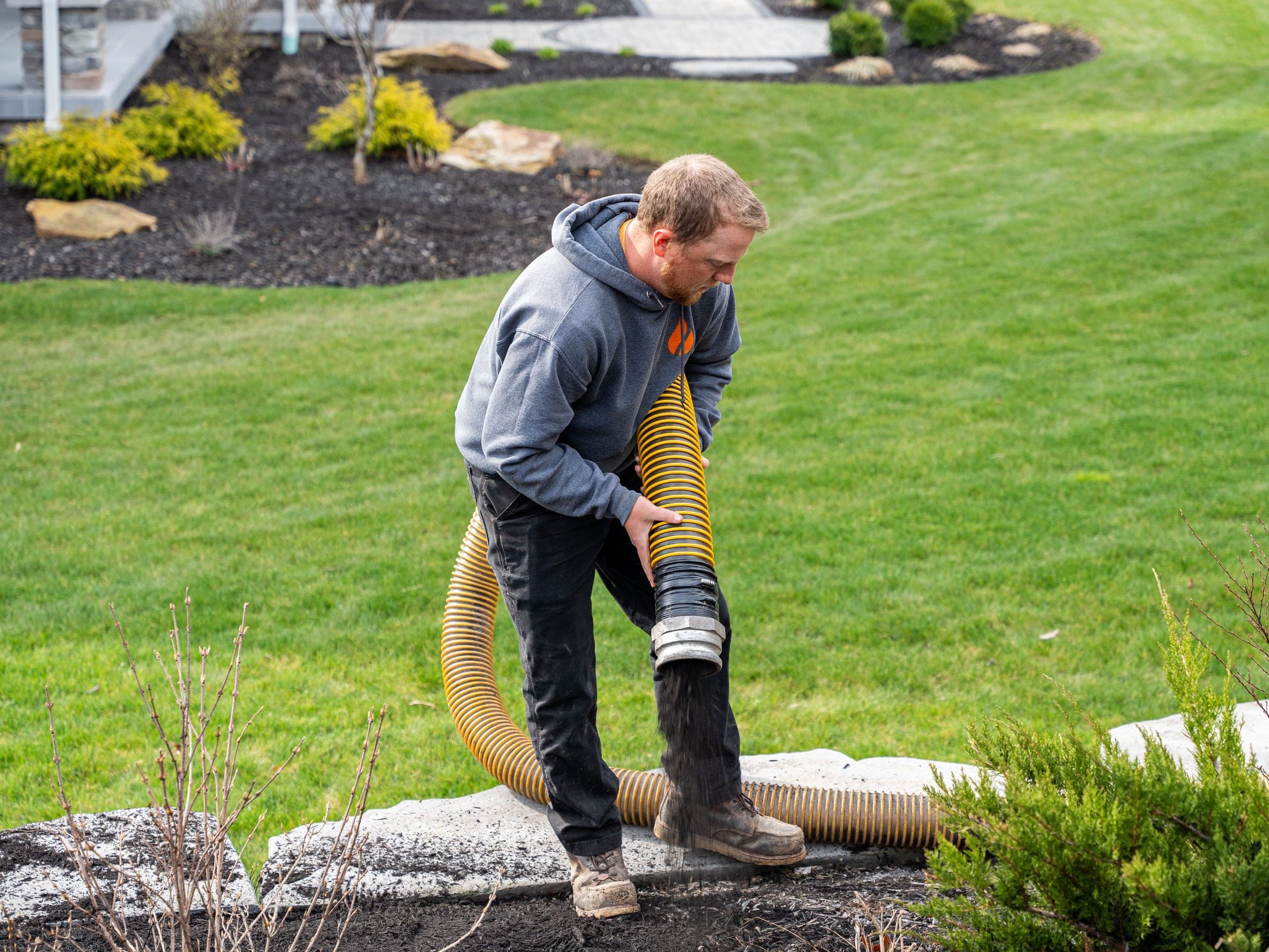
Past that, method matters as much as material. For our crews, hand spreading is often cheaper until roughly 10 to 15 yards, and above that blowing through a hose comes out ahead on time and cost; the full comparison, including the 150 foot hose reach, is in mulch blowing vs. hand spreading. A finished depth is a probe measurement, not an eyeball, and blowing does not change the yardage math on this page.
Common questions
Mulch math, straight answers.
How many bags of mulch are in a cubic yard?
A cubic yard is 27 cubic feet, so it holds 13.5 bags at 2 cubic feet each or 9 bags at 3 cubic feet each. Buy 14 of the smaller bags or 9 of the larger ones to match one yard.
How much mulch do I need for 100 square feet?
At 3 inches deep, 100 square feet takes 25 cubic feet, or 0.93 cubic yards. That is 13 bags at 2 cubic feet or 9 bags at 3 cubic feet. At 2 inches it drops to 16.7 cubic feet, about 9 of the 2 cubic foot bags.
How many square feet does one cubic yard of mulch cover?
324 divided by the depth in inches. That gives 162 square feet at 2 inches, 108 at 3 inches, and 81 at 4 inches. Our other guide rounds the 3 inch figure to 100 square feet per yard to leave room for settling.
Do I put new mulch over the old layer?
Measure what is left first. Add only enough to bring the total back to your target depth, and put that number, not the full depth, into the calculator. If the old layer has matted into a solid crust, break it up or pull it before topping up.
Picking the mulch is the other half.
Compare hardwood, bark, needles, and the rest in our mulch types for flower beds guide, or hand the whole bed to a crew and get a number from the landscaping cost calculator.