Every mulch does the same three jobs in a flower bed: it holds moisture, blocks weed light, and evens out soil temperature. What separates them is how long they last, what they do to the soil as they break down, and how they behave on your particular bed. We mulch beds across Beaver, Butler, and Allegheny counties twice a year, and the comparison below leans on university extension research wherever a claim is about plants or soil rather than about what looks good.
One rule of thumb before the table. Penn State Extension calls hardwood bark a very good, inexpensive mulch, especially a blend of bark, wood, and leaves. For most flower beds that is the answer, and the rest of this page is about when a different material earns its extra cost.
The comparison table
Cost is a relative tier, not a price, because bulk prices move by supplier and season. Depths are for weed control on a bed you have already weeded; the mulch for weed control guide covers how depth blocks light and why fabric under mulch backfires. Lifespans for hardwood, dyed mulch, nuggets, and needles come from that guide.
| Type | Lifespan | Cost tier | pH effect | Weed-blocking depth | Best for | Avoid |
|---|---|---|---|---|---|---|
| Shredded hardwood (undyed) | 1 to 2 seasons | Low | Small. The biggest drops in one Florida trial came from pine straw, pine bark, and cypress (Duryea 1999). | 2 to 3 in (Clemson) | Mixed perennial and shrub beds, foundation plantings, the everyday choice. | Mounding it against stems. Wood of unknown origin (see dyed mulch). |
| Dyed mulch (red, brown, black) | Wood lasts 1 to 2 seasons, color fades sooner | Mid | Same as the wood underneath. Carbon and iron oxide dyes show no evidence of toxicity. | 2 to 3 in | Beds by the front door or walk where a steady color matters. | Bags that will not name the wood source. Recycled waste wood can carry CCA, and dye that is not bound to the wood comes off on contact, especially when wet (UMass). |
| Pine bark nuggets | 2 to 3 seasons; softwood bark breaks down slower than hardwood (UMass) | Mid | A slight lean acid. Pine bark lowered pH in the Florida trial (Duryea 1999), but the effect is not enough to rely on. | 3 to 4 in per our weed control guide; Clemson and WSU say 2 to 3 in of bark is enough | Level shrub borders and tree rings, a coarser, chunkier look. | Steep slopes and runoff paths. Large nuggets float and move in heavy rain (Clemson). |
| Pine needles (pine straw) | About a year. Half the depth was gone in 12 months in the Florida settling trial (UF/IFAS). | Low, free if you rake your own | Little to none. UMass and WSU both say needles do not acidify soil in a 2 to 3 inch layer (UMass, WSU). | 3 to 4 in per our weed control guide; Clemson says 2 to 3 in | Azaleas, rhododendron, and sloped beds, because needles interlock and stay put. | Summer mulch in wildfire-prone landscapes (WSU). |
| Cedar (shredded) | Roughly like other shredded bark; we found no extension figure | Higher | No extension figure found. Do not buy it to change pH. | 2 to 3 in, as with any fine-textured mulch | Beds where you like the color and the smell. | Paying extra for pest control. The UF/IFAS bulletin on termites and mulch names no species; its advice is about depth near the foundation (ENY-832). |
| Compost, leaf mould, shredded leaves | 1 to 2 years (Clemson) | Low if you make it, mid if you buy it | Varies by batch. Oak and beech leaves acidify a little (Clemson). | Compost 1 to 3 in, shredded leaves 2 to 3 in (WSU) | Perennials, annuals, and new plantings where you want the soil to improve. | Whole leaves (they blow away), leaves with powdery mildew, and compost with weed seeds (WSU). |
| Stone (river rock, pea gravel) | No refresh, but debris collects on top and grows weeds | Highest | Can add alkaline elements (Clemson). | 1 in of small rock (Clemson); we lay 2 to 3 in over fabric | Foundation strips, paths, and dry sunny plantings with no perennials to divide. | Acid-loving plants, and hot sites: rock reflects sun and heats the bed (WSU). |
| Rubber (shredded tire) | Sold as permanent, but microbes break it down and it leaches (WSU) | Highest | Not the concern; zinc is. | Not recommended | Nothing in a flower bed. | All of it. WSU lists toxic zinc levels, high flammability, and weaker weed control than wood chips (FS163E). |
Shredded hardwood and dyed mulch
Shredded hardwood knits into a mat as it settles, which is why 2 to 3 inches holds weeds back. It decomposes faster than softwood bark because hardwood bark carries more cellulose (UMass Extension), and that breakdown is the point in a perennial bed: it feeds the soil. Plan on topping up every one to two seasons.
Dyed mulch is the same shredded wood with a colorant. UMass Extension’s colored mulch fact sheet says the dyes are carbon-based or iron oxide, and that there is no evidence they are toxic. The real risk is the wood. Recycled construction and demolition waste can be contaminated with creosote or CCA (chromated copper arsenate), so ask where the wood came from. Dye fades before the wood does, which is why a dyed bed needs a fresh coat of color before it needs fresh structure.
Pine bark and pine needles
Pine bark lasts longer than hardwood because softwood bark carries more lignin, waxes, and tannins (UMass Extension). Clemson’s mulch factsheet says 2 to 3 inches of pine bark controls weeds, and that big nuggets float in heavy rain. That is the reason we would keep nuggets on level beds and use needles or a fine shredded mulch where water runs.
The belief that pine mulch acidifies soil is mostly a myth at bed depth. UMass Extension says needles do not substantially change pH at 2 to 3 inches, and WSU says flatly that they do not acidify the soil as was once thought. In one Florida trial, soil under pine straw did move from pH 5.0 to 4.4 (Duryea, English, and Hermansen 1999), so a small lean is real on some soils. If you have hydrangeas or blueberries that need acid, test the soil and amend it; do not count on the mulch.
Needles also settle fastest. In the University of Florida settling trial, pine straw fell to half its depth in one year and was almost gone at two, while pine bark kept about two thirds of a 3.5 inch layer. Order needles deep, and expect an annual refresh.
Cedar
Cedar is sold on its smell and its reputation for repelling insects. We found no extension source that puts a number on how long cedar mulch lasts or what it does to soil pH, so the table says so. On pests, the University of Florida’s termite and mulch bulletin makes no case for cedar or any other species. What it does say is that mulch laid thicker than 4 to 6 inches can hide the inspection space along a foundation and help termites that are already established survive by keeping soil moist. Its practical advice applies to every material: a thin layer, under 2 inches, within 12 inches of the foundation, and about a 6 inch inspection gap. Buy cedar because you like the color and the smell.
Compost, leaf mould, and shredded leaves
These are the mulches that build soil fastest, and they are cheap if you have leaves. WSU Extension puts compost at 1 to 3 inches in flower and shrub beds and shredded leaves at 2 to 3 inches, and warns that leaves shredded too fine mat and shed water (WSU guide to mulches). Clemson says compost mulch may break down completely in 1 to 2 years. That is a feature in an annual bed you replant every spring and a cost in a shrub border you would rather not redo.
Stone and rubber
Stone belongs near the house or on a path, not in a perennial bed. It never needs replacing, but it reflects heat, and as leaves and dust settle into it, seeds germinate on top (WSU). Clemson adds that rock can add alkaline elements, which is a problem for azaleas and hollies. We keep stone for foundation strips with no plantings to divide later.
Rubber is the one material we tell people to skip. WSU Extension’s fact sheet on rubber mulch reviews the research: toxic zinc levels from tire manufacturing, leaf yellowing and higher tree mortality in trials, the most likely to ignite of a dozen organic mulches tested, and weaker weed control than wood chips. It is also sold as permanent, and microbes do break it down over time.
How to choose, in four questions
- Do you replant every year? Compost or shredded leaves. They feed the soil and you will disturb the bed anyway.
- Is the bed sloped or in a runoff path? Pine needles, which interlock, or a double-shredded mulch that knits as it settles. Skip nuggets and loose rock.
- Is it against the house? Keep it under 2 inches within 12 inches of the foundation, per UF/IFAS, or go to stone.
- Does color matter more than soil? Dyed hardwood, from a supplier who names the wood.
Depth and clearance, whichever you pick
Penn State Extension’s ceiling is 2 to 4 inches of organic mulch, dropping to 1 to 2 inches when it is finely textured, and its warning about mulch volcanoes holds for beds as well as trees: piling mulch against stems traps moisture and invites rot. Clemson says to keep mulch 2 to 3 inches away from stems. We spread in late spring once the beds are cleaned and new plantings are in, and again in early fall on properties that want sharp beds through autumn.
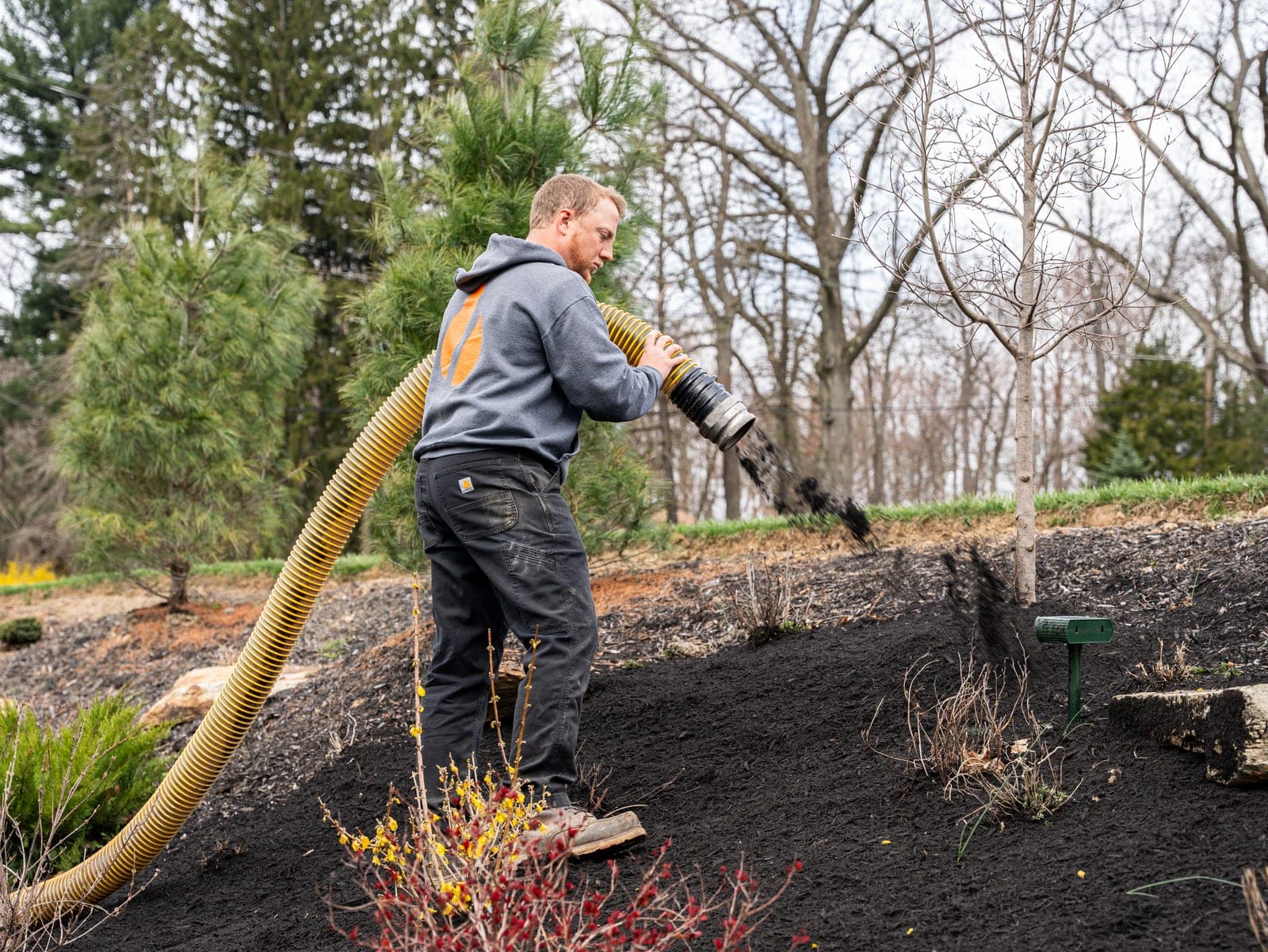
To turn a depth into a purchase, use the mulch calculator. A 200 square foot bed at 2.5 inches is 200 × 2.5 ÷ 324 = 1.5 cubic yards, or about 23 bags at 2 cubic feet each with a 10 percent cushion for settling. If the bed is large or spread around the property, blowing it in changes the labor, not the material. If you would rather hand the whole thing over, our landscaping team does it.