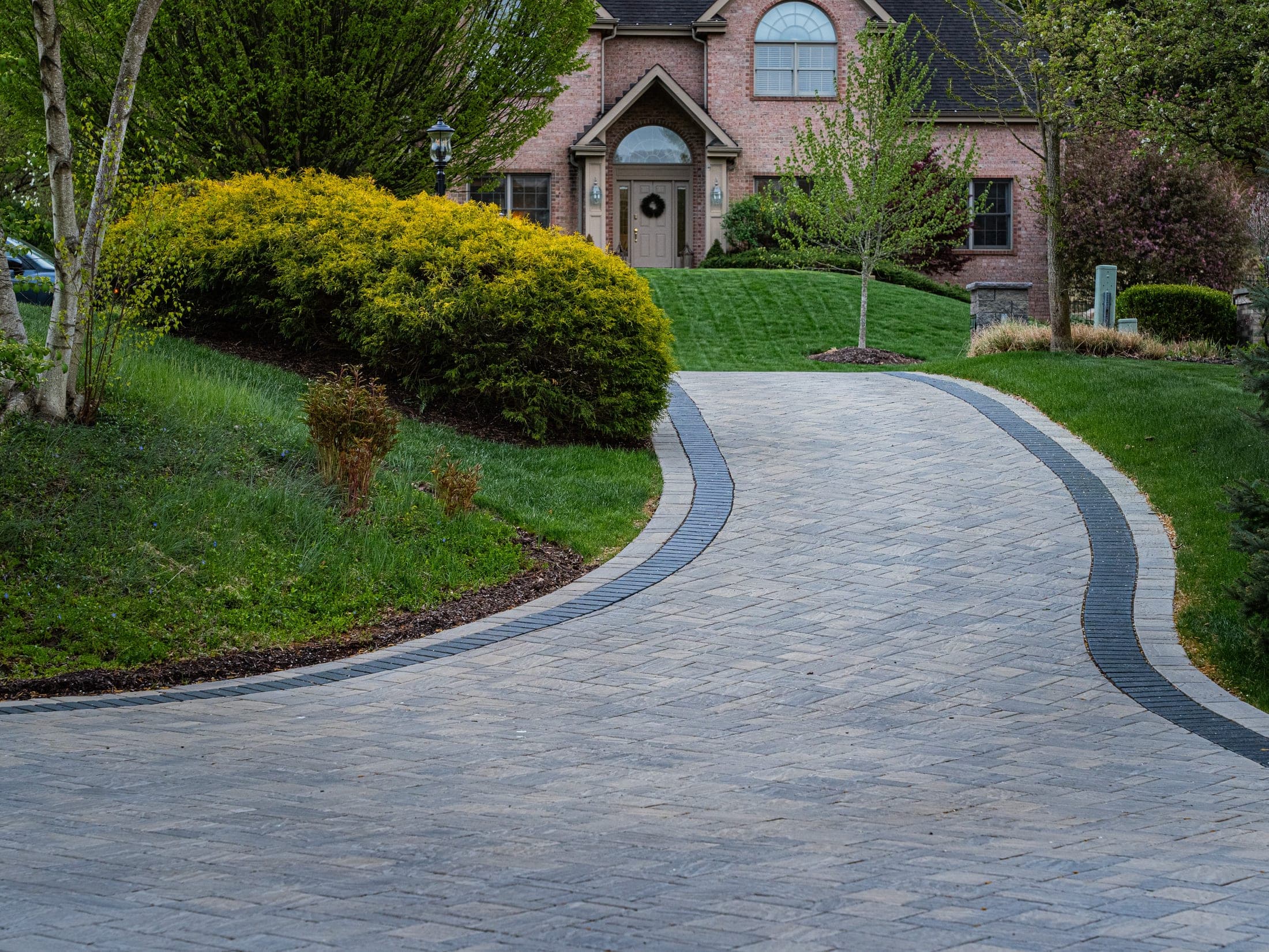
A driveway takes a vehicle’s weight every day and a plow blade all winter, and it sits through about 114 nights a year at or below freezing. In the National Weather Service’s 1991 to 2020 normals for Pittsburgh that is 113.6 nights, and 104 of them fall between November and March. Each of the four common materials answers that punishment differently, and the cost gap between them is wide enough to change the whole project.
This guide lays gravel, asphalt, concrete, and pavers next to each other, then goes deeper on two questions that come up most: how to protect and seal a driveway, and how to build a gravel one that holds. Every price and lifespan below links to the public source it came from. Our own driveway work is pavers and concrete, covered on our paver driveways page; this page is the reference for comparing all four.
Gravel, asphalt, concrete, and pavers side by side
Costs are national contractor-reported ranges from Angi’s 2026 cost guides (updated between April and July 2026), which include labor and standard base prep. Western PA quotes shift with access, grade, and drainage, so treat the table as a starting range.
| Gravel | Asphalt | Concrete | Pavers | |
|---|---|---|---|---|
| Installed cost per sq ft | about $1.30–$5.50, from Angi’s $800–$2,200 for a 400–600 sq ft drive, divided by area. Stone alone runs $10–$50 a ton. | $7–$13 new, $3–$7 for an overlay (Angi). NerdWallet puts it at $7–$15. | $8–$20: plain $6–$8, broom finish $8–$12, stamped $12–$18 (Angi). | $10–$18 standard, $18–$30 decorative (Angi). |
| Typical lifespan | 10 to 20 years if maintained (Angi). | 15 to 20 years, up to 30 with maintenance (NerdWallet). | 27.5 years on average, 30 to 40 with care (NerdWallet). | 30 to 40 years (Bob Vila). |
| Upkeep | Regrading, fresh stone, weed control: $100–$400 a year (Angi). Bob Vila calls the maintenance “considerable.” | First seal about six months after paving, then every three to five years (Angi). Cracks get filled first. | Bob Vila calls it low-maintenance. Sealer is optional and runs $0.85–$2.13 per sq ft (Bob Vila). | Top up joint sand once it drops more than 1/2 in.; inspect in spring and again in late summer or early fall (CMHA). |
| Freeze-thaw in Western PA | No slab to crack. The risk is a soft subgrade in March and stone pushed off the surface by plowing. Bob Vila says gravel is “not the best choice for snowy regions.” | Flexible, and the black surface sheds snow faster. Bob Vila says it “weathers freeze-thaw cycles better than concrete or pavers.” | Rigid, so it cracks as one piece. Air-entrained mix is the defense: 6.5 to 7 percent air for a salted driveway (FHWA). | Joints take the movement, and a settled section can be lifted and reset (ICPI). |
| Road salt | Nothing on the surface for salt to attack. It does burn the plants along the edge. | The deicer warnings in the sources here are about concrete and pavers. What hurts asphalt in winter is meltwater freezing in open cracks, so keep them filled. | Skip deicers the first winter (Concrete Network). Never use ammonium nitrate or sulfate (UNL Extension). | Rock salt is the least damaging deicer; avoid magnesium chloride and CMA (CMHA). |
| Sealing schedule | None. | Every 3 to 5 years after the first coat; sealer products last 2 to 4 years or more (Angi). | Optional. Wait at least 30 days after the pour (Bob Vila); a penetrating sealer limits moisture and chloride entry. | Optional. Reapply after wear and weather; acrylics last “a few years” (CMHA). |
What a 600 square foot driveway adds up to
A double-car driveway runs 400 to 600 square feet by Angi’s sizing. Multiplying the per-square-foot ranges above out to 600 square feet gives these totals.
| Material | The math | 600 sq ft driveway |
|---|---|---|
| Gravel | Angi's double-car range (400–600 sq ft) | $800 – $2,200 |
| Asphalt, new | 600 × $7 to 600 × $13 | $4,200 – $7,800 |
| Asphalt, overlay | 600 × $3 to 600 × $7 | $1,800 – $4,200 |
| Concrete | 600 × $8 to 600 × $20 | $4,800 – $12,000 |
| Pavers, standard | 600 × $10 to 600 × $18 | $6,000 – $10,800 |
| Pavers, decorative | 600 × $18 to 600 × $30 | $10,800 – $18,000 |
Our own pricing gives a local reference point for pavers. The patio cost calculator quotes $17 to $35 per square foot for a straightforward paver patio in Western PA. That is a patio figure, and a driveway needs a deeper base: ICPI puts driveway bases at 6 to 8 inches against 4 to 6 for walks (CMHA and ICPI application guide), and thicker again where freezing temperatures and weak soil call for it. Our project planner puts a mid-size broom-finish concrete patio or driveway at $5,000 to $12,000. Both figures come from the pricing behind that calculator, and a driveway gets its own site visit and its own quote.
Freeze-thaw and salt: what breaks in Western PA
Water is the whole story. It gets into a crack or a pore, freezes, expands, and widens the opening. The FHWA tech brief on air entrainment describes concrete that sees both freeze-thaw and deicing chemicals as its most severe exposure class, and sidewalks and pavements that receive deicers are its named example. For that class the recommended air content is 6.5 percent with 1-inch aggregate, 7 percent with 3/4-inch, and 6 percent with 2-inch, with a field tolerance of plus or minus 1.5 percent (FHWA-HIF-17-009, table 2). If you pour concrete, ask the supplier for that air content by number.
Timing matters as much as the mix. The University of Nebraska extension says new concrete should air dry at least 30 days before the first freeze and warns that ammonium nitrate and ammonium sulfate deicers damage concrete more than sodium chloride or calcium chloride do (UNL G1121). Concrete Network goes further and recommends skipping deicers entirely the first winter, because concrete under a year old has less freeze-thaw resistance than mature concrete (Concrete Network).
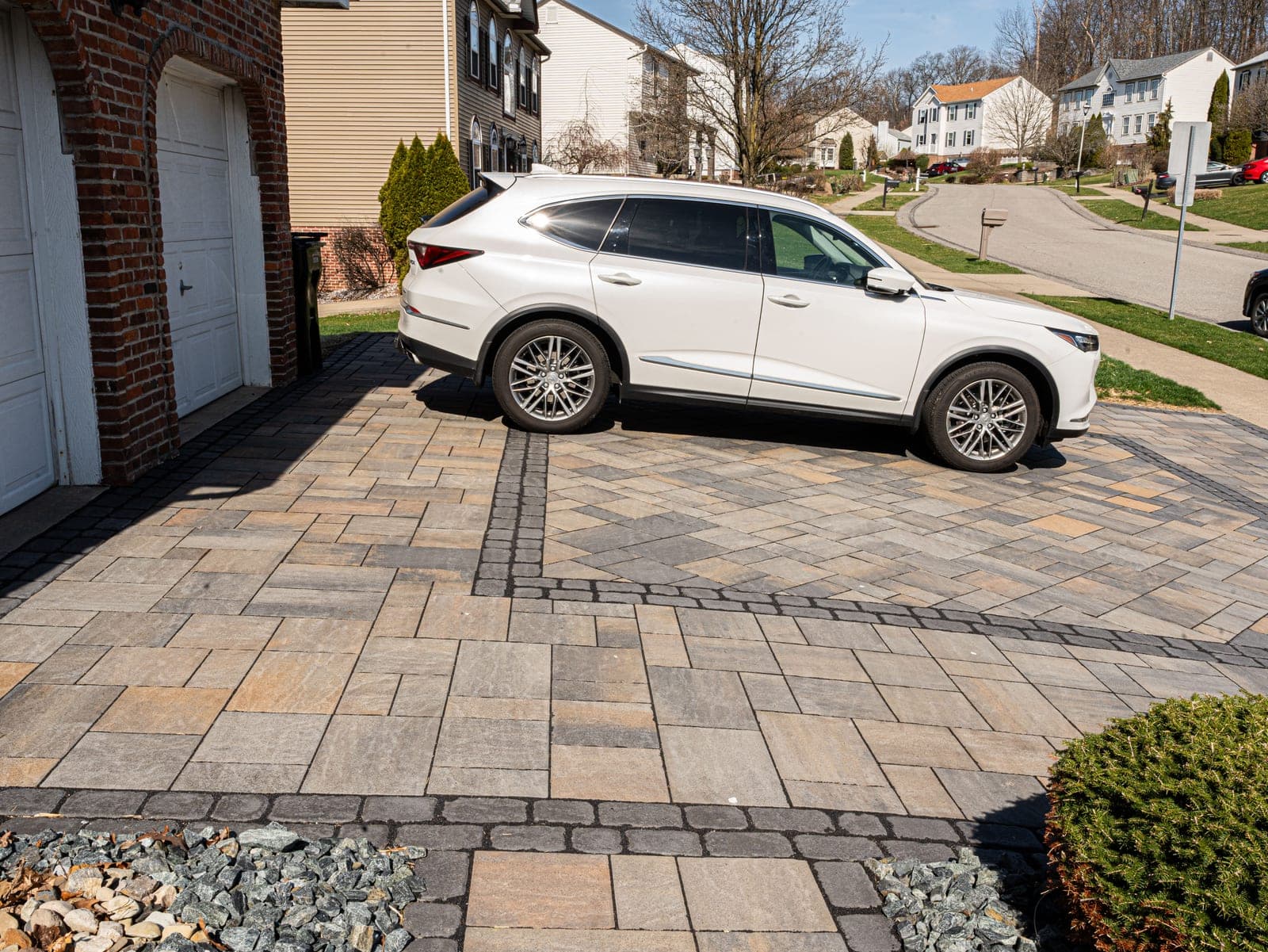
Pavers earn a reputation for handling salt. The CMHA maintenance guide calls rock salt the least damaging deicer for concrete pavers, allows calcium chloride sparingly, and advises against magnesium chloride and CMA (CMHA operation and maintenance guide). It also suggests shoveling and plowing diagonal to the joints so a blade does not catch a paver edge.
Gravel has a different problem. Stone that sits within about 24 inches of the surface in Pennsylvania goes through repeated freeze-thaw, and Penn State’s Center for Dirt and Gravel Road Studies lists soundness as the property that governs it, with PennDOT specifications capping the sodium sulfate loss at 10 to 20 percent depending on the stone (Aggregates 101). Buying PennDOT-spec stone from a quarry beats buying pit-run for a driveway.
Protecting and sealing a driveway
Sealing is the protection question people search for most, and it applies mainly to asphalt. Concrete and pavers take an optional sealer, gravel takes none. Here is what a coat of asphalt sealer costs, when it pays for itself, and when it does not.
What sealcoating costs
Angi puts professional driveway sealing at $1.25 to $1.50 per square foot for materials and labor, with a national average job of $575 (Angi). Bob Vila lists a $275 to $820 range and adds that a 500 square foot driveway takes about 5 gallons of sealer, which runs $30 to $100 (Bob Vila). On a 600 square foot driveway that is $750 to $900 from a contractor, or roughly 6 gallons and $36 to $120 in material if you do it yourself. Angi notes that many contractors charge a minimum, so a small drive can cost more per square foot.
| Sealer | Materials per sq ft | What to know |
|---|---|---|
| Asphalt emulsion | $0.08–$0.10 | Four years or more in the right conditions; stains from oil and gas. |
| Oil-based | $0.15–$0.20 | Up to four years; fills shallow cracks. |
| Latex acrylic | $0.20–$0.25 | Holds up to UV, resists staining, harder for a DIYer to spread. |
| Eco-friendly (soy-based) | $0.25–$0.38 | About five years, per Bob Vila. |
| Fill-and-seal | $0.35–$0.50 | Thick coat that fills bigger holes and cracks; a sealer coat goes on top. |
When it pays
Take the same 600 square foot driveway over 20 years. Angi says to seal about six months after paving and again every three to five years. At a four-year interval that is five coats, and at Angi’s professional price they add up to $3,750 to $4,500. New asphalt on that driveway costs $4,200 to $7,800. So contractor-applied sealing costs about what a replacement does, and it pays only if the coats carry the driveway well past the 15 to 20 year mark that NerdWallet gives as typical. The cost guides publish the price and the schedule but no measured number of years a coat adds, so a claim that sealing doubles pavement life is a contractor’s estimate.
The math tips clearly toward sealing in three cases. The first is DIY application: five coats at $36 to $120 of material each come to $180 to $600, though Bob Vila says most homeowners lack the experience and equipment to do it well. The second is a surface that is still tight, where the coat keeps water out of hairline cracks before they open. The third is a driveway bundled with crack filling, because sealer over an open crack only hides it. Bob Vila prices asphalt repair at $2 to $5 per square foot, so filling early is the cheaper end of the same problem.
Sealing leaves structural damage alone. When the surface is crumbling or has big holes, Angi says to price a new driveway (Angi), and its overlay range of $3 to $7 per square foot is the middle option (Angi).
The Western PA sealing window
Sherwin-Williams gives 50°F as the minimum temperature for sealing, 24 hours before anyone walks on it, 48 hours before a vehicle drives on it, and no application when rain is forecast within 48 hours (Sherwin-Williams). Pittsburgh’s 1991 to 2020 normals show a low of 32°F or colder on 6.3 days in April, 0.5 days in May, and 2.4 days in October (NWS normals). By those numbers mid-May through September is the reliable window in Western PA, and the shoulder months are a gamble.
Two more choices when you seal
Residential driveways usually get one coat, and Bob Vila suggests a second for heavy traffic or heavier vehicles. The second coat costs less than double because prep happens once. Sealer chemistry also matters: Bob Vila notes coal tar emulsion is banned in many areas because of its polycyclic aromatic hydrocarbon content, which is why acrylic, asphalt emulsion, and soy-based products are on the table above. Ask what is in the bucket before the crew opens it.
Protecting concrete, pavers, and gravel
Concrete: wait at least 30 days after the pour before sealing (Bob Vila), skip deicers the first winter, and consider a penetrating sealer that limits moisture and chloride entry. Pavers: top up joint sand when it sinks more than 1/2 inch, inspect twice a year, and reseal only when the surface shows wear. CMHA says sealers on pavers should go on after at least 24 hours without surface dampness, because sealing over moisture can leave the surface cloudy (CMHA). Our crews finish paver driveways with polymeric sand and sealing, described on the driveways page.
Gravel driveways: base depth and stone sizes
A gravel driveway is a stack of compacted layers with a wearing surface on top. The stone on top is the part you see. The layers under it decide whether the driveway is smooth in April or full of ruts.
How deep
Angi recommends 4 to 6 inches of gravel for a driveway and figures that 2.5 tons covers 100 square feet at 6 inches deep (Angi). That is the budget version. A fuller residential spec from a stone supplier stacks three layers: 4 to 6 inches of #3 stone as subbase, 3 to 4 inches of crusher run, and 2 to 3 inches of surface gravel, for 9 to 13 inches compacted. On clay or loamy soil the same source moves the total to 10 to 12 inches with geotextile fabric, and on heavy clay or poor drainage to 12 to 16 inches with 8 inches of #3 as the subbase (Bovees).
The volume math is worth doing before you order. At 6 inches deep, 600 square feet is 300 cubic feet, about 11 cubic yards, or roughly 15 tons at Angi’s 2.5 tons per 100 square feet. At Angi’s $10 to $50 a ton that is $150 to $750 of stone before delivery, which Angi puts at $100 to $500 a load. Double the depth to 12 inches and the tonnage doubles to about 30. Loose stone compacts to roughly 75 to 85 percent of its loose volume, so a 10-inch compacted base needs 12 to 13 inches placed in lifts.
Which stone
Pennsylvania aggregates carry both AASHTO numbers and PennDOT names, and the PennDOT list is what a local quarry sells. This table condenses Penn State’s Aggregates 101 bulletin, which cites PennDOT Publication 408, section 703, as the source of the specifications.
| Stone | Size range | Where it goes |
|---|---|---|
| #3 (PennDOT 3A) | 2.5 in down to 1/2 in, washed | Subbase. Open-graded, so it drains but does not pack into a dense layer. |
| 2A (subbase) | 2 in down to dust, 0–10% fines | Compacted base. Built as the base under asphalt, and the fines let it pack dense. |
| #57 (PennDOT 2B) | 1.5 in down to 3/32 in, washed | Top course where drainage matters. Clean stone drains well and compacts poorly. |
| #8 (PennDOT 1B) | 1/2 in down to 3/32 in, washed | Chip surfacing and a small-stone top dressing. |
| 2A modified | 2A with extra fines added | A term many Pennsylvania quarries and municipalities use; “modified” is not an official specification. |
The split to remember is open-graded versus well-graded. Clean stone like #3 and #57 has air voids, drains well, and does not pack into a dense layer. Well-graded stone like 2A has fines that let it compact, and the Penn State bulletin points to well-graded stone wherever compaction matters, road surfaces included. The crusher run layer in the spec above is the role 2A plays in Pennsylvania, since PennDOT designed 2A as a base for placing asphalt.
Crown and drainage
Penn State recommends a cross-slope of 4 to 6 percent on unpaved surfaces, which is 1/2 to 3/4 inch of fall per foot of width (Crown and Cross-Slope bulletin). On a 12-foot driveway crowned down the center, each side is 6 feet wide, so the center sits 3 to 4.5 inches above the edges. A driveway that is flat holds water, and water is what turns a base into ruts.
Gravel is the lowest-cost material to install and the one that asks the most from the owner afterward. Angi budgets $100 to $400 a year for regrading, fresh stone, and weed control. If you would rather build something that does not need a rake, the same base thinking applies under a paver driveway, with a concrete driveway as the other hard-surface option we install.
Driveway material questions, answered
Which driveway material is cheapest per square foot?
Gravel, by a wide margin. Angi’s double-car range is $800 to $2,200, against $4,200 to $7,800 for 600 square feet of new asphalt. The gap narrows over time, since gravel carries $100 to $400 a year in upkeep and the harder surfaces last longer.
Which material handles Western PA winters best?
Bob Vila’s driveway guide gives asphalt the edge on freeze-thaw. Pavers give a different kind of protection: the surface is individual units on a compacted base, so a section that settles can be lifted and reset. Concrete is rigid and cracks as a single piece, which is why the mix and the first winter matter so much. Pittsburgh sees about 114 days a year with a low at or below 32°F (1991 to 2020 normals), so every option gets tested.
When can I seal a new asphalt driveway?
About six months after it is paved, per Angi. The sealer needs 50°F or warmer and no rain in the 48-hour forecast, so in Western PA that points to mid-May through September.
Is sealcoating an asphalt driveway worth the money?
Sealing yourself costs a few hundred dollars over the life of a 600 square foot driveway. Paying a contractor at $1.25 to $1.50 a square foot for five coats runs $3,750 to $4,500, close to the price of a new driveway, so the value depends on whether the coats keep the surface sound for a long stretch. The full math is in the sealing section above.
Can I salt a concrete driveway?
Not in its first winter, per Concrete Network, and the University of Nebraska extension says new concrete should air dry at least 30 days before the first freeze. After that, rock salt and calcium chloride are the milder options and ammonium nitrate or sulfate deicers are the ones to avoid. Sand gives traction without touching the surface.
How deep should a gravel driveway be?
One supplier’s residential spec totals 9 to 13 inches compacted: 4 to 6 inches of #3 stone, 3 to 4 inches of crusher run, and 2 to 3 inches of surface gravel. Angi’s budget version is 4 to 6 inches total. Clay soil pushes the number up, and the detail is in the gravel section above.
Pricing a driveway in Western PA
Paver and concrete driveways start with a site visit, because grade, drainage, and soil set the base depth before any square-foot number means anything. Start with the patio cost calculator for a paver or concrete range, look at finished work on the driveways page, or run your project through the project planner.
Sources
Checked September 28, 2026.
- Angi cost guides: asphalt driveway (April 2026), concrete driveway (April 2026), paver driveway (April 2026), gravel driveway (July 2026), sealing an asphalt driveway (May 2026)
- NerdWallet, asphalt vs. concrete driveway (updated September 2025)
- Bob Vila: 9 Popular Driveway Options, driveway sealing cost
- CMHA / ICPI: application guide, operation and maintenance guide, cleaning, sealing, and joint sand stabilization
- FHWA tech brief, Air Entrainment and Concrete Durability (November 2019)
- University of Nebraska extension G1121, Winter Deicing Agents for the Homeowner; Concrete Network, ice melt and concrete
- Penn State Center for Dirt and Gravel Road Studies: Aggregates 101, Crown and Cross-Slope
- NWS Pittsburgh 1991 to 2020 monthly normals; Sherwin-Williams, how to seal a driveway; Bovees, gravel driveway base thickness
Elements figures on this page come from our patio cost calculator and the project planner behind it.