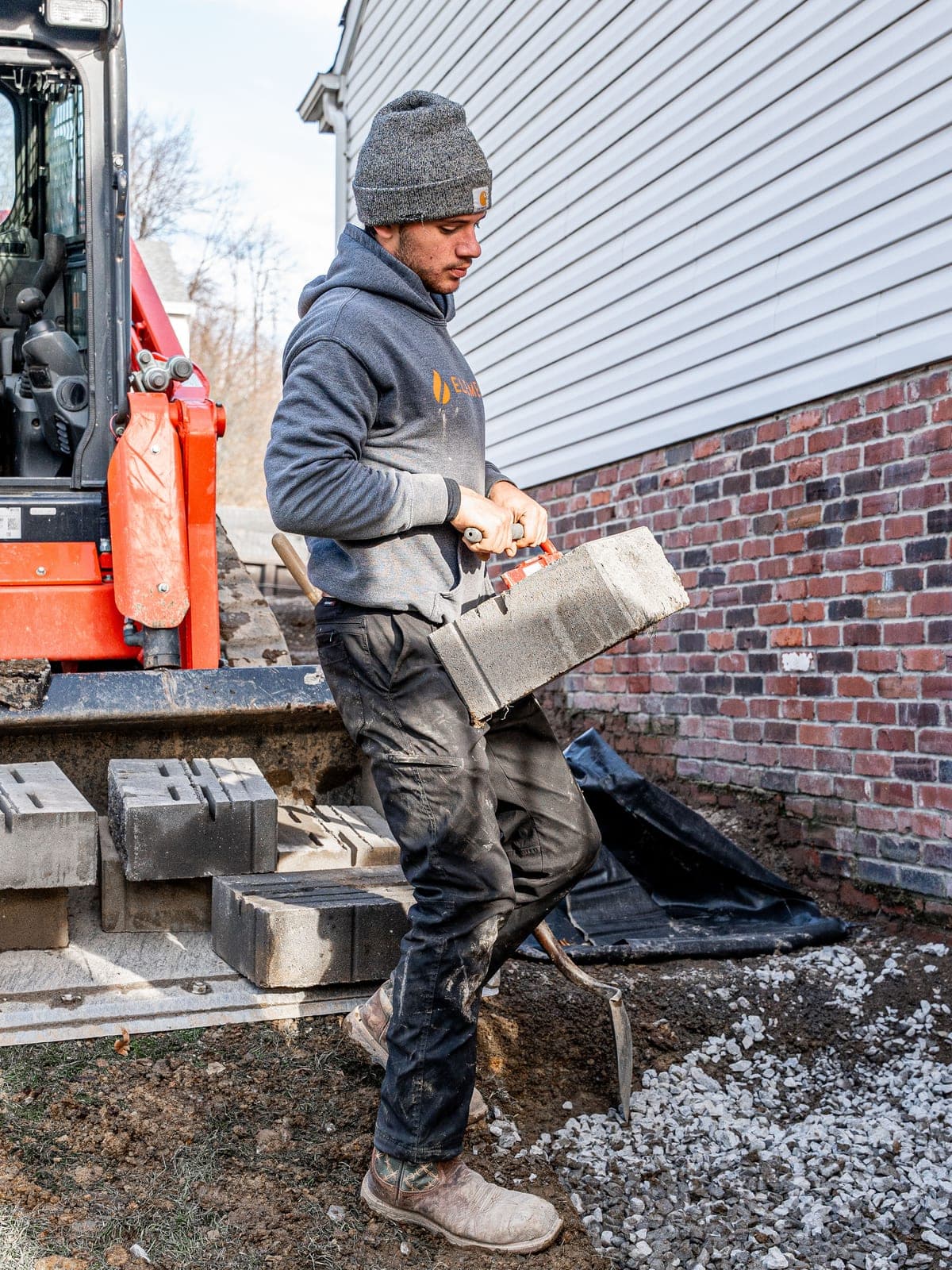
We get called out to look at a lot of failing retaining walls, and almost none of them fail because the block was wrong. A bulging Versa-Lok wall, a wall leaning forward at the top course, a wall with a crack running diagonal through it: in nearly every case the block did its job and the water behind it did not get anywhere to go. If you are pricing a wall on our retaining wall price calculator, it is worth understanding what is actually holding that wall up, because it is not the part you can see.
Base prep, the part nobody sees
Every wall we build starts below grade with a compacted crushed stone base, typically six to twelve inches deep depending on wall height, dug below the frost line where the wall calls for it. The base has two jobs: it spreads the load of the wall and whatever is behind it, and it drains. A base that is under-dug, poorly compacted, or built on native clay instead of stone will let the first course settle unevenly, and an uneven first course telegraphs up through every course above it. We compact in lifts, not all at once, and we check the base is level before a single block goes down. Skipping this step is invisible on installation day and obvious in year three.

Drainage behind the wall
Behind every segmental wall we build, there is a zone of clean, angular drainage stone, usually #57 washed stone, wrapped in non-woven filter fabric so soil fines cannot migrate in and clog it. A perforated drain pipe runs along the base of that stone zone and daylights somewhere downhill, or ties into a solid pipe that carries the water well clear of the wall. That system exists to do one thing: get water that lands or seeps behind the wall out from behind the wall before it builds pressure. Without it, water sits in the soil directly against the back of the blocks.
Water is heavy. A cubic foot of saturated clay weighs meaningfully more than the same soil dry, and that added weight pushes forward against the wall as hydrostatic pressure. A wall engineered to hold back soil was never engineered to hold back soil plus standing water. That is the single biggest cause of the bulging and leaning walls we get asked to fix.
What clay soil does through a Western PA winter
Most of Butler, Allegheny, and Beaver County sits on heavy clay with pockets of shale. Clay is nearly impermeable on its own, it holds water instead of shedding it, and it expands when it freezes. A wall backfilled with native clay instead of stone will trap water against the block face every winter and push on the wall with every freeze cycle. Over one winter that is not much. Over ten winters of freeze and thaw, it is enough to walk a wall forward inch by inch until it fails. This is why we never backfill a structural wall with the dirt that came out of the hole, no matter how much cheaper that would be on installation day.
Segmental block vs. poured concrete
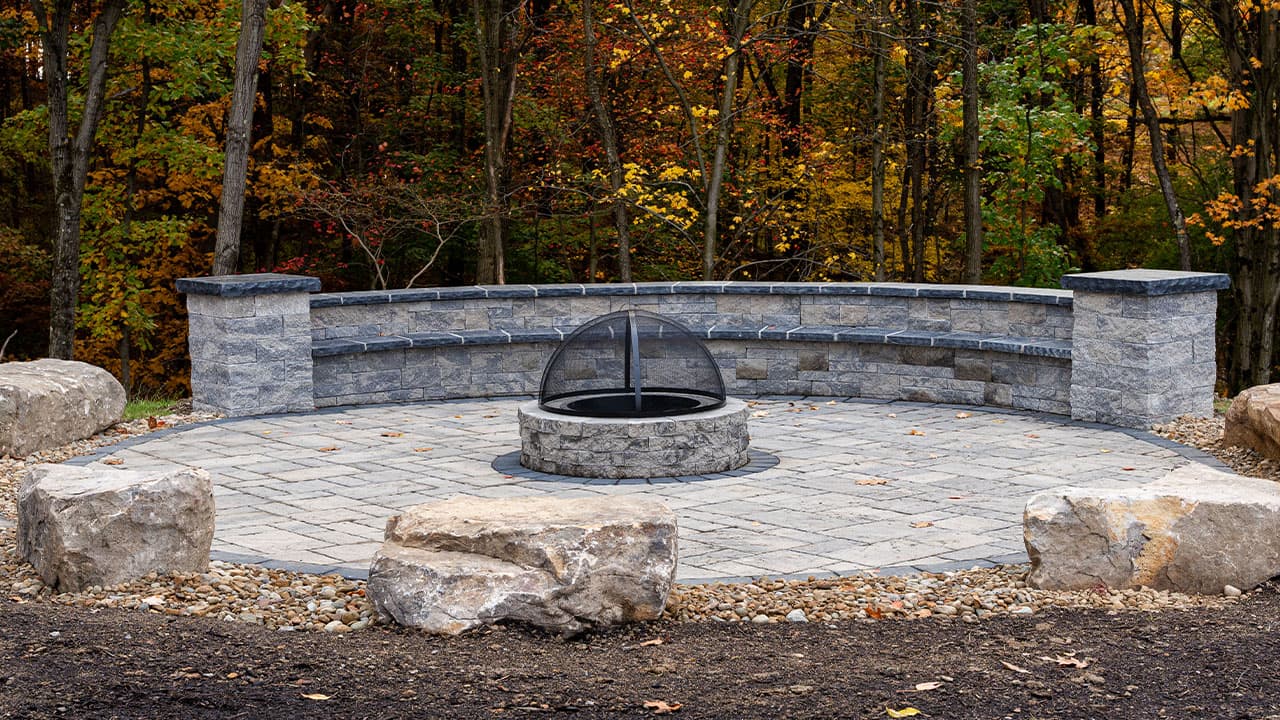
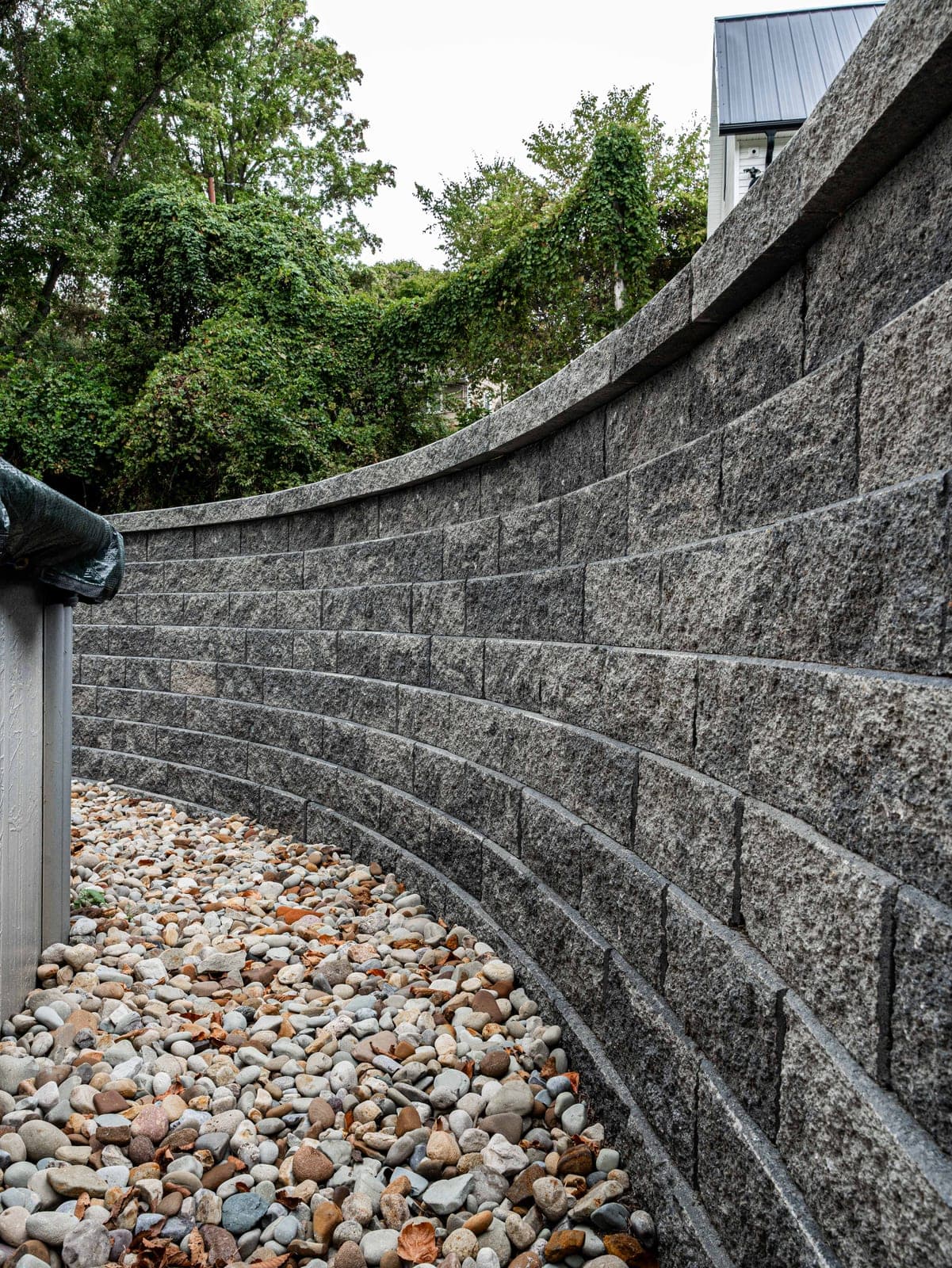
We build almost exclusively with segmental block systems like Versa-Lok rather than poured concrete for walls under roughly six feet. Segmental units interlock and flex slightly as the ground shifts through freeze-thaw instead of cracking as one rigid piece. Each course also gives us a natural place to build in the drainage zone as we go, rather than trying to retrofit weep holes into a poured wall after the fact. Taller walls or walls carrying a significant surcharge (a driveway or a pool pad sitting behind them) get engineered with geogrid reinforcement tied back into the compacted backfill, which is a different conversation than a standard three or four foot garden wall.
Signs a wall is already in trouble
A few things worth walking outside to check on an existing wall. Look for a horizontal bulge partway up the face, especially after a wet spring. Look at the top course from the side and see if it leans forward compared to the base course. Check for a crack running diagonally rather than a hairline settling crack. Look for water actively seeping through the face rather than through the drain outlets, which usually means the drainage system behind it either was never installed correctly or has clogged. None of these mean a wall needs to be torn out immediately, but all of them mean it is worth a look before another winter works on it.
If you are scoping a new wall and want real numbers before you call anyone, start with our retaining wall price calculator. It estimates materials, dimensions, and cost, and it is built on the same base and drainage assumptions we actually build to.